

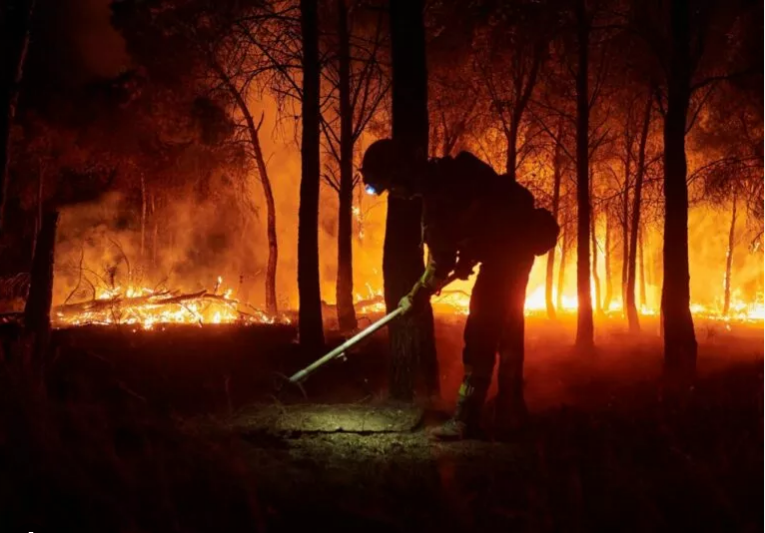
When Summer Devours Our Mountains Once Again
A year ago, I wrote an article entitled “When Summer Devours Our Mountains.”
I wrote it after one of the most devastating summers we can remember. Spain was burning. Wildfires were destroying thousands of hectares, villages, farms, animals and lives. And as we watched those heartbreaking images, many of us asked ourselves the same questions: What are we doing wrong? Why do we keep arriving too late? Why do we talk about prevention when the forest is already on fire?
Twelve months later, sadly, I am writing about the same thing again.
And, honestly, it keeps me awake at night.
Because the summer of 2026 has given us no respite either.
As of 31 August, Spain had provisionally recorded 264,656 hectares burned and 44 major wildfires. It is true that this figure is lower than that recorded at the same point in 2025, but it is still an appalling figure.
And these are not just numbers. Behind the statistics lies something that figures can never fully convey:
There are forests that took decades to grow.
There are animals that could not escape.
There are farmers and livestock breeders who have lost part of their livelihoods.
There are families who have had to leave their homes.
There are villages that have once again watched the flames approach with fear.
And there is a natural heritage that cannot recover overnight.
WE KEEP ARRIVING TOO LATE!
I do not want to get into political debates. I do not want to look for someone to blame from behind a desk, nor turn a tragedy into an ideological battle.
I want to talk about something much simpler: prevention.
Because we keep arriving too late. We keep fighting fires when we should have been working for months to prevent them.
And the problem begins much earlier.
It takes shape when our forests accumulate tonnes of vegetation and dry fuel. When paths disappear. When firebreaks do not receive the necessary maintenance. When agricultural land is abandoned. When the livestock that grazed our mountains for generations disappears. When we stop making sustainable use of forest resources. When our rural villages lose inhabitants and economic activity. And when we turn the countryside into a landscape that may appear protected on paper, but is increasingly vulnerable to extreme wildfires.
A recent study on the 2026 wildfires reveals that almost 30% of the area burned up to 24 August was located within protected natural areas. Legal protection alone does not prevent fire from entering. The research itself points to factors such as extreme weather, continuous vegetation and the accumulation of fuel.
And here lies one of the key issues that we still seem unwilling to confront:
Protecting nature also means managing it.
Our forests need activity.
For centuries, our mountains and forests were used and cared for by the people who lived there.
Extensive livestock farming, agriculture, timber harvesting, firewood collection, maintaining paths, sustainable hunting and so many other activities were part of a rural model in which people and nature coexisted.
Perhaps it was not perfect.
But people lived in the villages.
There was livestock.
There were cultivated fields.
There were paths.
There was sustainable use of the land.
There was vigilance.
There was constant management.
Today, in far too many places, the countryside has been emptied of people while our forests have become increasingly full of fuel.
And then we are surprised when the fire comes.
There is a phrase that people from the countryside taught me many years ago:
“Wildfires are put out in winter.”
And every year I become more convinced that there is no simpler or more accurate way of putting it.
Winter is the time to clear the land.
To remove scrub.
To create and maintain firebreaks.
To restore access roads and paths.
To manage biomass.
To create breaks in continuous vegetation.
To recover agricultural areas.
To encourage grazing.
To work with forest landowners.
To plan.
To invest.
To prepare our forests for summer.
Because when temperatures reach 40°C, the wind picks up and the vegetation is completely dry, it is already too late to start thinking about what we should have done.
And what about our wildfire crews?
Here is another issue that I still struggle to understand.
Why do we continue to treat so many wildfire professionals as seasonal workers?
The men and women who face the flames during the most difficult months accumulate invaluable experience and knowledge of the land — knowledge that we should be making use of throughout the entire year.
We need professionals working in winter too.
We need teams dedicated to prevention, maintenance, monitoring, clearing and forest management.
Would that mean stable employment?
Of course.
It would mean knowledge.
It would mean economic activity.
And, importantly, it would also help bring people back to our rural villages and keep them alive.
We cannot afford to leave our forests neglected for eight months of the year and then expect to solve everything during the months of greatest fire risk.
That is why I believe the time has come to change our approach.
We must stop asking only how many hectares have burned and start asking how many hectares we have managed to protect.
We must stop measuring only the resources we deploy once a fire starts and start measuring how much we are investing in preventing that fire from starting in the first place — or from becoming uncontrollable.
We must stop talking about prevention as if it were simply a nice word and turn it into a genuine, long-term national policy.
Because next summer will come.
Because next summer’s wildfires are being put out today.
And we can no longer say that we did not know.