

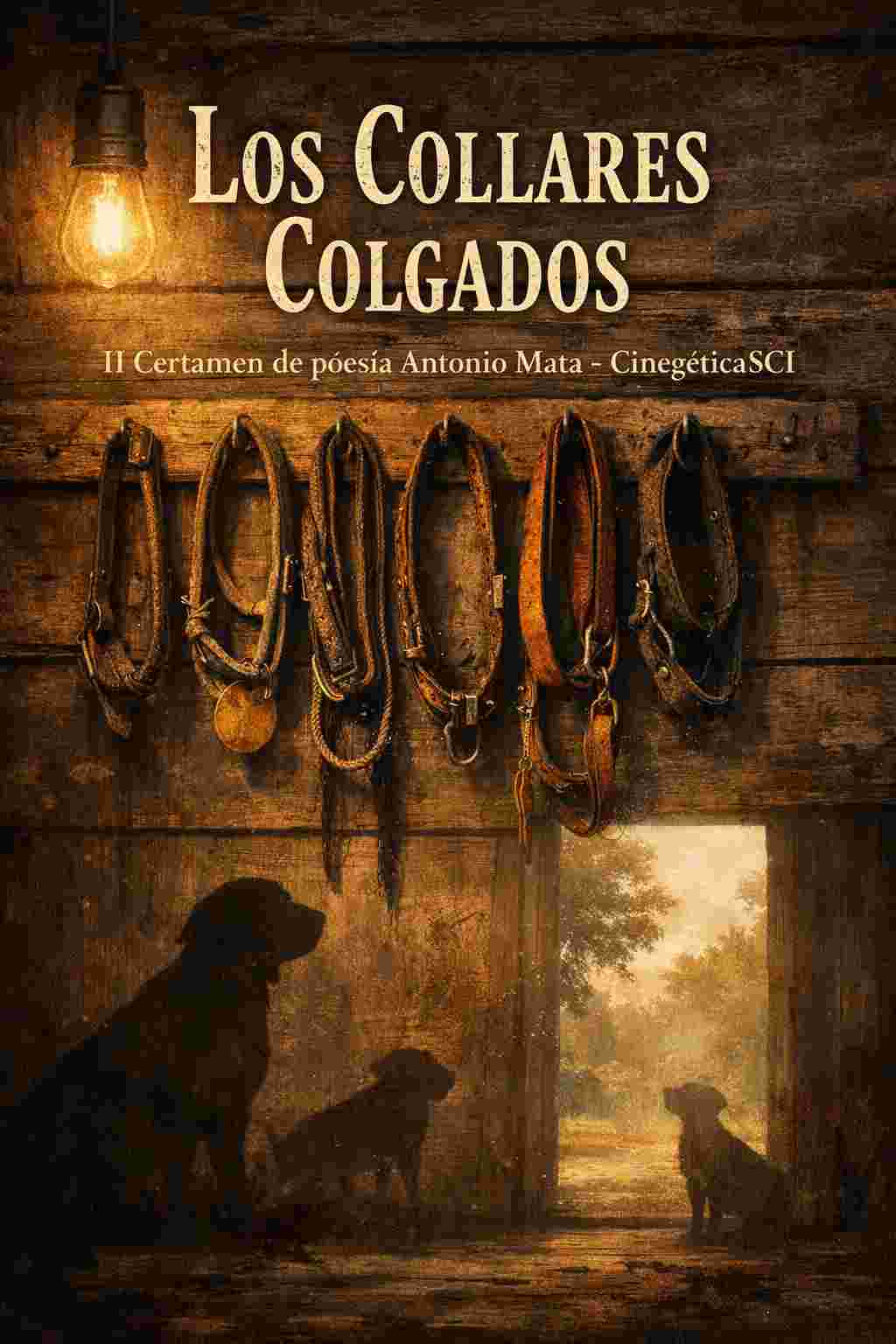
THE HANGING COLLARS
The man opened the shed door before dawn had fully arrived. The cold air entered first, carrying that damp scent left behind by the night as it recedes, clinging stubbornly to clothes. The padlock clicked as it turned, and the wood gave way slowly. Inside, the darkness seemed to wait. He turned on the yellowish bulb, which always took a second to assert itself. The flashlight was now useless. The shed was small: four unplastered walls, a low ceiling, a table under the window, a bench by the wall, and occupying almost the entire left side, a wooden board where the collars hung.
There was every kind: old leather, worn buckles, pieces of rope replacing lost parts, tags with names erased by time. They were not arranged like trophies, yet neither were they in disorder. They seemed to have found their place on their own. The man laid his cap on the table, ran a hand across his forehead, and looked at the wall. He did this every time he entered. There was never any hurry in that place. Time didn’t command so much either.
In his right hand, he held a new collar, still stiff. He held it for a few seconds, more out of necessity than indecision. He stepped forward. Up close, he could see the marks of the years on the wood: scratches, old oil stains, a small half-moon shaped cut. As so often, he began by remembering the first one.
Tano arrived when everything still seemed in its place. A neighbor had reported that some puppies had been left by the bridge over the stream, and he went down with a fruit crate. Of the three, one was already dead. The other two barely breathed. Only one survived the night. It had a mark on its back shaped like a map, and someone said “Tano,” without thinking much. The name stuck, and no one argued.
He grew clumsy, cheerful, stubborn, with a clear gaze that disarmed any reproach. He got used to sleeping near the fireplace. In winter, when the fire held the afternoons, he would lie close enough to feel the warmth, but never so close that the smoke bothered him. He followed every small gesture in the house with his eyes. He expected nothing. Being near was enough.
One afternoon, he didn’t return. He searched for hours. The house filled with a thick, heavy waiting that was hard to move. On the third night, he heard a whimper in the garden. Tano came back limping, scratched all over, a branch stuck in his paw. There was no fear in his eyes. Only exhaustion. He tended him patiently, without a word. That night, the dog didn’t leave the home. He slept, breathed deeply, and occasionally opened an eye to check that everything was still there.
Years passed. When Tano died, the man dug behind the shed and whispered his name. Nothing more was needed. Then he cleaned the collar, oiled it, and hung it on the wall. He didn’t know it then, but he was inaugurating something. A gesture that would repeat over the years.
Chispa arrived after a time of calm. She was small, restless, impossible to contain. Everything about her seemed accelerated. She ran after every shadow, barked at the air if the wind shifted direction, and stared at an ant as if it were an event. One day she disappeared for longer than usual, and worry grew. They found her in a ravine, collar caught on a branch. She had fought until surrendering, but she was alive. During storms, she sought refuge under the table, trembling until her body obeyed again.
Illness came too quickly. He stepped into the yard to breathe before going back inside. When he hung her collar next to Tano’s, the gesture already had form. It was not a tribute. It was not a farewell. It was a quiet way of saying, “You were here.”
Moro was different. He had a scar on his side and a calmness no one had taught him. He didn’t impose himself, didn’t demand attention, but he was always there. One winter, fog covered the paths, and the man realized he was lost. It wasn’t panic. It was an uncomfortable certainty. Then he felt a nudge on his leg. Moro was there. He took a few steps, stopped, and looked back. The man followed without hesitation. He never knew if the dog knew the way or if chance did the rest, but they returned. From then on, when someone asked about Moro, the answer came short, with half a smile.
Luna arrived when the house had already grown too big. His daughters had moved away. Silence weighed at certain times of the day. She settled in quietly, as if she didn’t want to disturb. They walked every afternoon along the same path, at a pace marked by age. Luna began to limp. The vet explained the obvious. The winter was long. She slept by the stove and lifted her head whenever he shifted position. The day she could no longer stand, the house was filled with a different silence. He took weeks to hang her collar. When he finally did, he opened the window and stood for a long minute, not counting the time, letting the air fill his body.
From then on, the ritual was written forever: clean, hang, name, and keep silent.
The shed smelled of worn wood and rope. Boots rested by the door. The bench always held the same folded blanket. Through the window, a piece of the countryside could be seen, seemingly unchanged though it shifted daily. He still went out to the fields, though less. In the square, conversations went from rain to feed prices, to children who no longer lived there. No one ever asked about the collars. They weren’t a secret. They belonged to that part of life one rarely speaks of.
The body began to mark limits. Knees protested. Hands moved slowly in the morning. A slope forced him to stop. The elder daughter took him to the doctor. There were recommendations. The younger one said maybe it would be better not to have more dogs. The granddaughter, however, floated a sentence: “Grandpa without a dog isn’t grandpa.” He barely smiled.
The possibility returned: a litter without a home. That night he slept half-awake. It wasn’t worry. It was a faint call. The puppy arrived on a Saturday morning. Clumsy paws. Big ears. Surprised gaze. By mid-afternoon, they were in the shed. The dog stayed in the doorway, watching. He hung the new collar, still empty, among the others. He whispered a name, though it was not final. He did not intend to replace anyone. Just to acknowledge that life went on.
It was a peculiar time. He began to adjust his pace, unconsciously. He walked slower, took detours to avoid slopes, rested in the shade with a natural ease he hadn’t had before. The puppy learned to wait for him. Not obedience, but another way of being together.
The granddaughter came by more often. She entered the shed carefully, as if she knew there was something not to be touched too much. One day she asked if he kept the collars to remember. He answered, to keep them from disappearing entirely. She pointed to the empty collar. She said she hoped it would be long before it was used. He corrected nothing. He knew time had its own way of speaking.
The name finally settled: Faro. No one chose it. It just happened. Over time, the animal began to sleep near the bed when the wind moved the shutters. That discreet presence was enough.
Years passed, without major events, with the calm of the everyday. He accepted his limitations. Faro adapted his energy. The shed remained the place where life could be observed without too many words. The man opened the door, turned on the light, sat on the bench, and let silence do the rest. Faro preferred to stay in the doorway. No one had explained it. Yet he respected it.
Sometimes, while looking at the wall, the man remembered specific scenes: a frosty morning, a summer afternoon when the well water tasted fresher than usual, a brief conversation in the square about anything unimportant. All of it somehow returned to the collars.
One day, the granddaughter asked what to do with the shed when he was gone. He replied that they should take care of it. And that the collars must remain there, especially if Faro was still alive. She nodded with a new seriousness.
There were long summers, clear autumns, winters with blankets and stove. Deeper fatigue came too. Faro began to walk slowly. He stopped climbing the hill. Still, whenever he could, he returned to the shed. Opened the door. Looked at the wall. There, memory did not weigh. It accompanied.
One winter afternoon, the light came in low. Dust floated motionless. The world seemed frozen. The man sat on the bench, more tired than other days. He remembered Tano, Chispa, Moro, and Luna. Then the following years came to mind. He did not feel sadness. What arrived was a quiet gratitude, almost physical, that needed no name.
Faro was in the doorway, still, as he almost always was. He didn’t need to enter to be with him. There was something in that way of accompanying that spoke for itself.
Then he understood something he had sensed for years without forming it. He did not hang the collars to cling to what had gone. He did it to care for what remained. Each being that passed through his life taught him a way of being in the world. Fidelity was not in objects, but in the gesture of returning and looking. In continuing to name what one does not want to disappear.
He rose slowly. Placed his hand on the wood. Said a name. Maybe several. He turned off the light and left. The wind moved the branches. Faro walked at his side, not touching, but not leaving.
The granddaughter, when she started going alone, did exactly the same. It was not a topic they discussed, but both knew what it meant. Over time they had learned to understand each other without too many explanations.
The countryside changed slowly. Almond trees bloomed some years more generously than others. The rains came late some springs, early in others. New neighbors learned the names of the paths. Everything seemed to move and, at the same time, remain.
In the shed, the collars stayed hung. They were not there to remember the past, but to give a place to what had been lived. Something that sustains without asking for anything in return. Over time, the yellowish bulb continued to turn on each morning with that second of delay, and while that happened, a part of all that had been shared would remain, even if no one said it aloud.